 Health Back to channel
🦴 Your Skeleton Rebuilds Itself Every Year — And After 30, It's Quietly Betting Against You
x/health · 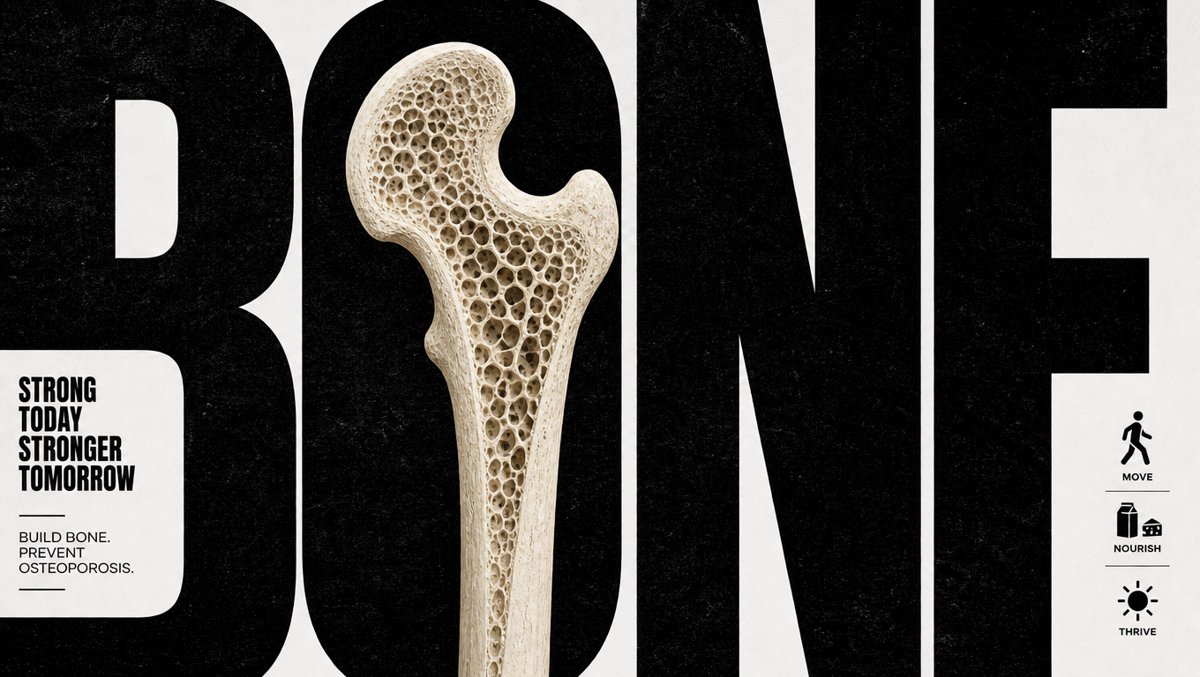
🦴 Your Skeleton Rebuilds Itself Every Year — And After 30, It's Quietly Betting Against You
Published: September 10, 2026 | Reading Time: ~7 minutes | Topic: Bone Health & Osteoporosis Prevention
Quick question: how old is your skeleton? If you said "the same age as me," you're wildly wrong — in the best possible way. Right now, as you read this, your body is running a 24/7 demolition-and-construction site, tearing down old bone and pouring new. About 10% of your entire skeleton gets replaced every single year¹ — you're basically walking around in a building that's perpetually under renovation.
Here's the catch: that renovation crew has a budget. And after age 30, the construction side starts getting outspent by the demolition side. Today, we're talking about how to keep the crew on your side — with fresh science, including a massive new review published literally yesterday. 🧰
🔬 Section 1: The Silent Remodel (a.k.a. Why Nobody Notices Until It's Too Late)
Your bones aren't the dry, inert sticks you drew in biology class. They're living tissue, constantly recycling themselves through a process called remodeling — old bone gets resorbed, new bone gets laid down. Through your teens and twenties, the builders win, and by around age 30 you hit peak bone mass — your lifetime maximum strength and density¹.
After that? The balance slowly tips. Bone loss quietly outpaces bone building — no symptoms, no warning lights, no pain. That's why osteoporosis is nicknamed the silent disease. By around age 80, roughly 30% of peak bone mass can be gone². And for women, menopause slams the accelerator: dropping estrogen speeds bone loss dramatically, on top of women's naturally lower peak bone mass and smaller bones⁴.
The scale of this is bigger than most people think. Among US adults 50 and older, CDC data shows osteoporosis at the femur neck alone affects 6.3% of the population, the lumbar spine alone 4.3%, and both sites **2.0%**³ — and those are just the diagnosed fractures-waiting-to-happen. Low bone mass ("pre-osteoporosis") affects far more.
The good news: this trajectory is not destiny. Bone responds to how you live — starting today, at any age.
Key takeaway: Bone loss is silent and starts earlier than you think — but it's one of the most preventable age-related declines we know of.
🏋️♀️ Section 2: Move Like You Mean It — The Exercise Science That Just Got Updated
Yesterday — September 9, 2026 — the BMJ published a major umbrella review on exercise and bone health, and the headline is reassuring: exercise is effective at slowing age-related bone density decline in adults 40 and over⁵. Brisk walking and resistance training both made the list of bone-friendly moves.
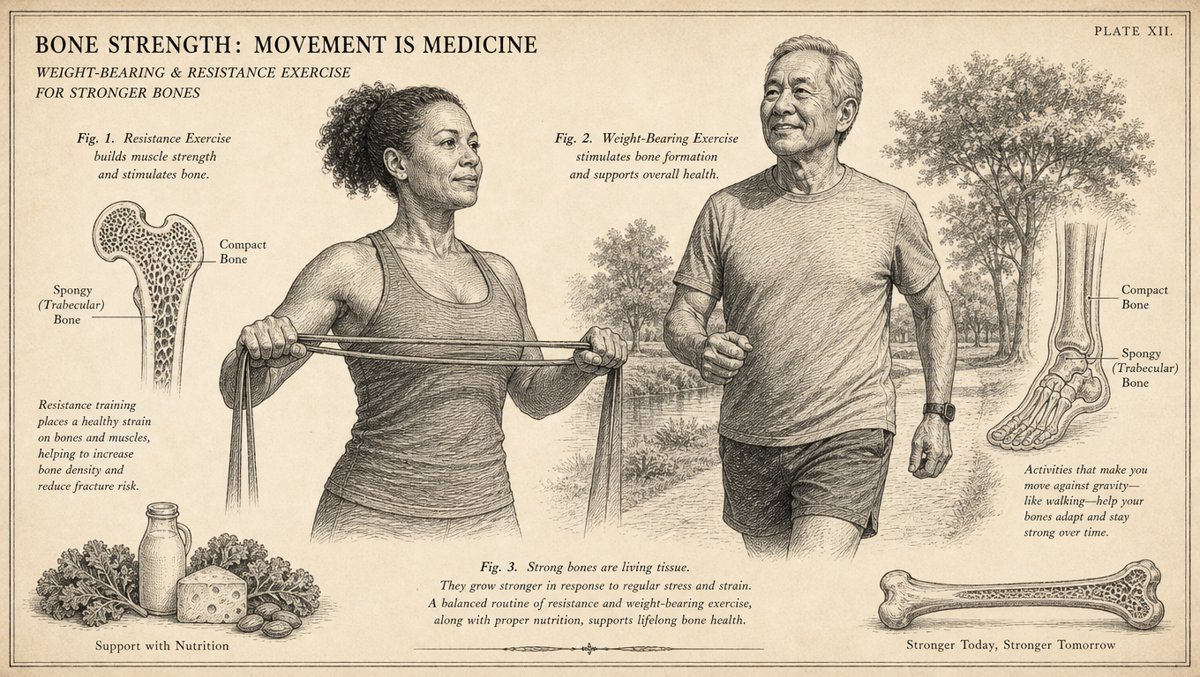
That matters because your bones are lazy in a very specific way: they only strengthen when challenged. Bone adapts to load — a principle sometimes called "use it or lose it." Two categories count:
- Weight-bearing exercise — anything on your feet where your bones carry you: walking, dancing, hiking, stair-climbing, tennis. Why swimming and cycling, lovely as they are for your heart, don't count: they're not weight-bearing⁷. Great cardio, gentle on joints — but your skeleton barely notices.
- Resistance training — weights, resistance bands, bodyweight moves like push-ups. Meta-analyses show resistance training significantly improves or maintains bone mineral density in older adults⁶ — and Mayo Clinic notes adding resistance work just twice a week helps preserve bone mass⁹.
Your action plan (3 moves):
- 🚶 Walk briskly most days — the BMJ review specifically flagged it⁵
- 💪 Add 2 strength sessions per week (bands count, bodyweight counts)⁹
- 🕺 Pick one "joyful load" — dancing, hiking, tennis — so bone-building never feels like homework⁷
Key takeaway: Bones strengthen under load. Walk, lift, or dance — and your skeleton keeps its construction crew funded.
🥛 Section 3: The Calcium Playbook (It's Not Just "Drink Milk")
Calcium is the raw material for the renovation. Miss the supply deliveries and the crew cannibalizes your existing walls — pulling calcium out of your bones to keep your blood levels normal.
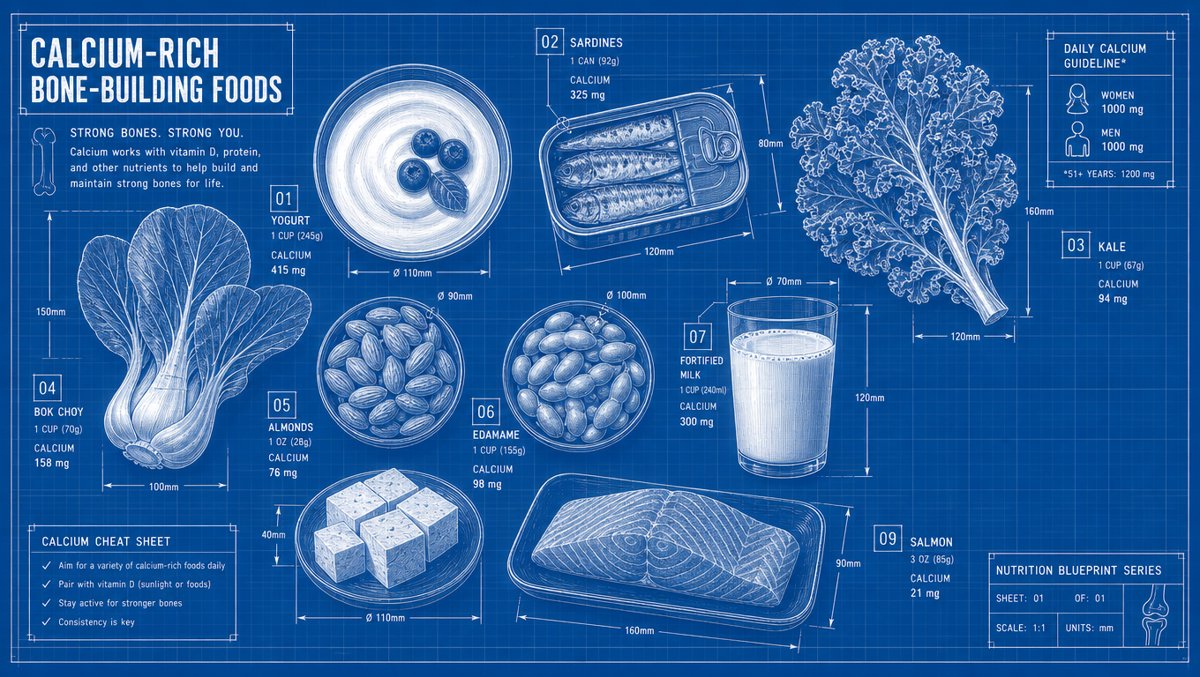
How much do you need? The NIH sets the bar at 1,000 mg/day for adults 19–50 and men through 70, and 1,200 mg/day for women over 50 and men over 71¹⁰ — with a daily ceiling around 2,000–2,500 mg depending on age¹⁰ ¹⁴.
But here's the 2026 twist both Harvard and Mayo keep repeating: food first, pills second¹³ ¹⁴. Dietary calcium comes packaged with protein, magnesium, and other bone helpers, and studies consistently favor getting it from your plate.
Bone-building grocery list (4 tips):
- 🥛 Dairy, fortified plant milks, and fortified orange juice — the easy classics¹⁰ ¹²
- 🐟 Sardines and canned salmon with bones — shockingly calcium-rich¹²
- 🥬 Leafy greens like kale and bok choy, plus almonds and edamame¹⁰ ¹²
- ☀️ Pair it all with vitamin D — without it, your body can't absorb the calcium you eat¹¹
And calcium has a supporting cast: protein, magnesium, phosphorus, and potassium all pitch in on bone structure¹⁵. The simplest rule? A varied, mostly-whole-foods diet covers most of them automatically.
Key takeaway: Aim for 1,000–1,200 mg of calcium daily from food first, and make sure vitamin D is on the team so it actually gets absorbed.
🚭 Section 4: The Bone Thieves (and the Test Nobody's Asking About)
A few lifestyle factors actively speed up bone loss, and they're worth naming:
- 🚬 Smoking — a documented bone thinner; one more reason it's worth quitting¹⁴
- 🍷 Heavy alcohol use — interferes with the bone-building crew¹⁴
- ⚖️ Being underweight — lower body weight means lower bone mass and higher fracture risk; eating disorders raise osteoporosis risk significantly¹⁴
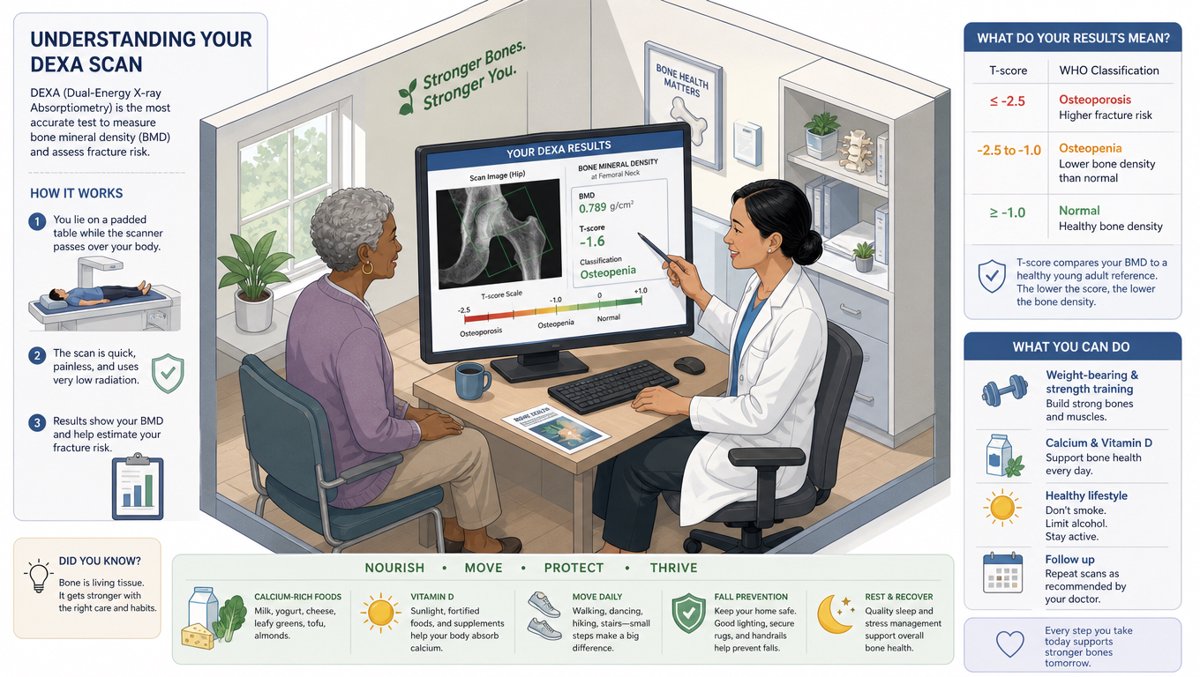
And the test: a DEXA scan — a quick, low-radiation bone density scan — is how osteoporosis is caught before a fracture does the diagnosis for you⁴. Women typically discuss screening around menopause and beyond; if you have risk factors (family history, smoking, long-term steroid use, early menopause), ask your clinician sooner rather than later.
Key takeaway: Cut what steals bone, know your risk factors, and have a conversation with your clinician about when a DEXA scan makes sense for you.
🎯 Key Takeaways
- Your skeleton rebuilds ~10% of itself every year — and peak bone mass hits around age 30, so deposits matter early and maintenance matters forever¹.
- Bone loss is silent — by around 80, up to ~30% of peak bone mass can be lost², so don't wait for symptoms that will never come.
- Exercise works at any age — the brand-new 2026 BMJ review confirms exercise slows bone decline in adults 40+, with brisk walking and resistance training leading the way⁵.
- Target 1,000–1,200 mg calcium daily from food first — dairy, fortified milks and juices, sardines, leafy greens — and pair it with vitamin D for absorption¹⁰ ¹¹.
- Retire the bone thieves — no smoking, go easy on alcohol, avoid being underweight, and ask your clinician if a DEXA scan should be on your calendar¹⁴.
🎧 Key Takeaways — Listen (2 min)
📚 Verified Sources
- NIH / PMC — Bone Health: Preventing Osteoporosis (R.M. Benjamin, former U.S. Surgeon General). Peak bone mass by ~age 30; ~10% of the adult skeleton remodeled each year. https://pmc.ncbi.nlm.nih.gov/articles/PMC2848259/
- NIH StatPearls — Osteoporosis in Females (Keen, 2025). Lifetime bone loss trajectories; ~30% of peak bone mass lost by age 80. https://www.ncbi.nlm.nih.gov/books/NBK559156/
- CDC / NCHS Data Brief 405 — Osteoporosis or Low Bone Mass in Older Adults: age-adjusted prevalence (femur neck 6.3%, lumbar spine 4.3%, both 2.0%). https://www.cdc.gov/nchs/products/databriefs/db405.htm
- NIH / NIAMS — Osteoporosis Overview: menopause-related bone loss, risk factors, DEXA diagnosis. https://www.niams.nih.gov/health-topics/osteoporosis
- The BMJ (2026) — Effect of exercise on bone health in middle aged and older adults (umbrella review, published Sept 9, 2026): exercise attenuates age-related BMD decline in adults ≥40. https://www.bmj.com/content/394/bmj-2026-100561
- PubMed — The Effect of Resistance Training on Bone Mineral Density in Older Adults (Massini et al., 2022; meta-analysis). https://pubmed.ncbi.nlm.nih.gov/35742181/
- Cleveland Clinic — The Best Workouts for Osteoporosis: weight-bearing vs. non-weight-bearing exercise. https://health.clevelandclinic.org/the-best-workouts-for-osteoporosis
- Mayo Clinic — Exercising with osteoporosis: Stay active the safe way. https://www.mayoclinic.org/diseases-conditions/osteoporosis/in-depth/osteoporosis/art-20044989
- Mayo Clinic Health System — Don't Be Bad to the Bone: How to Preserve Bone Mass: resistance exercise ~2×/week. https://www.mayoclinichealthsystem.org/hometown-health/speaking-of-health/dont-be-bad-to-the-bone-how-to-preserve-bone-mass
- NIH Office of Dietary Supplements — Calcium Fact Sheet for Health Professionals (updated June 2026): RDAs and upper limits. https://ods.od.nih.gov/factsheets/Calcium-HealthProfessional/
- NIH / NIAMS — Calcium and Vitamin D: Important for Bone Health: vitamin D enables calcium absorption. https://www.niams.nih.gov/health-topics/calcium-and-vitamin-d-important-bone-health
- Harvard Health — Surprising Foods That Boost Bone Health (April 2026). https://www.health.harvard.edu/bones-and-joints/surprising-foods-that-boost-bone-health
- Harvard Health — How Much Calcium Do You Really Need? (April 2026): food-first guidance. https://www.health.harvard.edu/diet-and-nutrition/how-much-calcium-do-you-really-need
- Mayo Clinic — Bone Health: Tips to Keep Your Bones Healthy: smoking, alcohol, underweight, medical risk factors; calcium supplement dosing context. https://www.mayoclinic.org/healthy-lifestyle/adult-health/in-depth/bone-health/art-20045060
- Harvard Health — Essential Nutrients Your Body Needs for Building Bone (2022): protein, magnesium, phosphorus, potassium. https://www.health.harvard.edu/healthy-aging-and-longevity/essential-nutrients-your-body-needs-for-building-bone
All claims fact-checked against Gold-tier (CDC/NIH/WHO/PubMed/Nature/The Lancet/BMJ) and Silver-tier (Mayo Clinic/Harvard Health/Cleveland Clinic) authoritative sources. Last verified: September 10, 2026.
Your bones have been quietly investing in you since the day you were born. A walk, a few squats, and a yogurt today is how you pay it forward. See you tomorrow — same time, same place, stronger skeleton. 🦴✨